Thursday, September 9, 2010

Announcements and Eucharist


I am always a bit disconcerted when a priest interrupts the rhythm of the Divine Liturgy to make routine – and often mundane – announcements. We are gathered in the presence of angels and archangels, in the company of saints and martyrs, in the fellowship of the church in heaven and the church on earth and the best we have to say is, “And don’t forget the potluck brunch next Sunday morning between services”? Right after the passing of the peace and right before we lift up our hearts to the Lord, why must we hear about choir practice, and the budget committee meeting, and the prayer luncheons, and all the rest of the nuts-and-bolts of church business/busy-ness?

Why? Because it is part of our lives and part of our life together, and because the essence of worship is bringing all that we have and all that we are before the Lord and making of it there an offering: all the things we deem holy and all the things we deem mundane. Because singing in the choir and balancing the budget and serving on church committees, all of it is good work – work done through the grace of God and work done for the glory of God. Because we intend to celebrate the Eucharist and it is fitting and right to remember the extraordinary ordinariness of a life in Christ with great thanksgiving. Because we seek direction and blessing in all the routines of our life together.

One post-communion prayer in the 1979 Book of Common Prayer captures the integral connection between our Eucharistic worship and our daily work beautifully:

Almighty and everliving God,
we thank you for feeding us with the spiritual food
of the most precious Body and Blood
of your Son our Savior Jesus Christ;
and for assuring us in these holy mysteries
that we are living members of the Body of your Son,
and heirs of your eternal kingdom.
And now, Father, send us out
to do the work you have given us to do,
to love and serve you
as faithful witnesses of Christ our Lord.
To him, to you, and to the Holy Spirit,
be honor and glory, now and for ever. Amen.

And so we connect our meetings and our ministries and our daily work and lives to the holy mysteries of the Eucharist where everything is sanctified, where everything is given meaning through the most precious Body and Blood of our Lord Jesus Christ.

The problem, it seems, is not with the announcements, but with a heart that fails to see the stuff of announcements as the real in-breaking of the Kingdom of God. So, just perhaps, I won’t be too disconcerted by the announcement of the potluck brunch between services next Sunday. It, too, is a holy meal. Amen.

Tuesday, September 7, 2010

Sin And All "That"


18 For I consider that the sufferings of this present time are not worthy to be compared with the glory which shall be revealed in us. 19 For the earnest expectation of the creation eagerly waits for the revealing of the sons of God. 20 For the creation was subjected to futility, not willingly, but because of Him who subjected it in hope; 21 because the creation itself also will be delivered from the bondage of corruption into the glorious liberty of the children of God. 22 For we know that the whole creation groans and labors with birth pangs together until now. 23 Not only that, but we also who have the firstfruits of the Spirit, even we ourselves groan within ourselves, eagerly waiting for the adoption, the redemption of our body (Rom 8:18-23, NKJV).

We were – each of us – born into a world conditioned and malformed by sin. Rain, which should fall from the heavens to water the earth, bringing forth life and giving growth, seed for sowing and bread for eating[1], falls instead to flood and destroy crops and villages and lives. The earth, founded upon the firm pillars of the creative word of God – “Let there be…” – trembles and quakes and levels massive skyscrapers and fragile shantytowns. Drought parches fertile land and devastates the hope of farmers. Fires rage, licking up forests and blackening the air with smoke. The earth itself bears witness to ancestral sin.

So, too, do we. Sin resides in our DNA. We, the image-bearers of God, are born corruptible, spiraling downward toward non-being from the moment of our first breaths.[2] We see it in the sickness of bodies and souls, in useless limbs and deaf ears and blind eyes. The outside of some us mirrors the inside of all of us.

1 Now as Jesus passed by, He saw a man who was blind from birth. 2 And His disciples asked Him, saying, “Rabbi, who sinned, this man or his parents, that he was born blind” (John 9:1-2, NKJV)?

It is a logical question in a culture that correlates personal sin to personal calamity, with cause and effect certainty. And, as scripture maintains, the true answer is yes, this man and his parents have sinned, and the cumulative sins of fathers and mothers and sons and daughters from ages past have produced a sin-infested world in which children are born blind. But the apostles are looking for a more direct causal relationship: some particular sin of the parents or child that resulted in this particular affliction. “Rabbi, who sinned, this man or his parents, that he was born blind?” It is all there in the little word "that", hina in the Greek of the New Testament: that – indicating cause and effect. Whose sin directly caused the man’s blindness?

While all illness is ultimately caused by sin, Jesus disabuses his disciples of the notion that this particular illness is caused by that particular sin; there simply is no one-to-one correlation of personal sin to personal infirmity.

3 Jesus answered, “Neither this man nor his parents sinned, but that the works of God should be revealed in him (John 9:3, NKJV). This man’s blindness is not the result of specific personal sin – either the man’s or his parents’ – but rather it is the opportunity for God’s power and glory to be manifest in and through the restoration of sight. It is all there again in the little word "that": that – this time indicating purpose and result. Though the world is ravaged by sin, though men and women are broken by iniquity, God’s purpose through it all is to manifest his power and glory in and through the restoration of all things: that the works of God should be revealed in him.

There is much darkness in the world, but God is working in the darkness that light may be manifest:

5 “As long as I am in the world, I am the light of the world.” 6 When He had said these things, He spat on the ground and made clay with the saliva; and He anointed the eyes of the blind man with the clay. 7 And He said to him, “Go, wash in the pool of Siloam” (which is translated, Sent). So he went and washed, and came back seeing (John 9:5-7, NKJV).

Sin and all “that.” Amen.


[1] See The Second Song of Isaiah, BCP 1979, p. 86.
[2] See On the Incarnation, St. Athanasius.

Monday, August 30, 2010

Prophets and History


There is no secular history.
Fr. David Sincerbox

Orthodox Christians believe that the world – this world – is the arena in which God – Father, Son, and Holy Spirit – works out the salvation of mankind and indeed the restoration of the entire created order (cf Rom 8). History is the record, in time, of that work. Thus, as Anglican deacon, Fr. David, rightly says, “There is no secular history.” If, as we pray, the Heavenly King, the Comforter, the Spirit of Truth is everywhere present and filling all things, then God is present in all times, working through all events for the reconciliation of the world. No event – past or present – is devoid of God. No event – past or present – may be understood apart from God. This is the wisdom of the prophets, to see God’s movement in and through history for the renewal of all things – not secular history, but holy history.

Joel is a case in point. He sees the same devastating plague of locusts that his countrymen witness, but he discerns more. They see insects; he sees the army of God. They see natural disaster; he sees holy chastisement. They see starvation; he sees fasting. They see hopelessness; he sees blessing:

25I will restore to you the years that the swarming locust has eaten,the hopper, the destroyer, and the cutter, my great army, which I sent among you.
26 "You shall eat in plenty and be satisfied, and praise the name of the LORD your God, who has dealt wondrously with you.And my people shall never again be put to shame. 27 You shall know that I am in the midst of Israel, and that I am the LORD your God and there is none else.And my people shall never again be put to shame.

28 "And it shall come to pass afterward, that I will pour out my Spirit on all flesh;your sons and your daughters shall prophesy, your old men shall dream dreams, and your young men shall see visions.29 Even on the male and female servants in those days I will pour out my Spirit (Joel 2:25-29, ESV).

They see secular history; he discerns holy history, the hand of God at work in the world and for the world. This is the unique charism of the prophets: to discern the presence and activity of God in the ordinary and extraordinary events of the day and to awaken us to the eternal dimensions of history. “Thus says the Lord,” is the prophets’ response to all history. Picking out his words distinctly from amidst the surrounding clamor is the gift and vocation of the prophets.

On the evening of September 11, 2001 my wife was scheduled to officiate at Evening Prayer in a large, Episcopal parish. Generally at such services the attendance ran somewhere between 3 to 5 people, including the officiant and lector – but not on that night. On that night the chapel was full to overflowing. People came looking for a prophet. People came to hear someone say, “Thus says the Lord.” People came looking for the presence and activity of God in the extraordinary events of the day, looking for the eternal dimensions of the present-moment tragedy. That same scene was repeated at churches throughout the country and at churches abroad. In that moment, in all such moments, the world believes – or at least hopes – that my brother David is right, that there is no secular history. For, if history is secular, then it is without meaning and without redemptive power.

Where is God in a terrorist attack? Where is God when hurricane after hurricane and then earthquake devastates further the already destitute Haitian people? Where is God in the midst of the rising floodwaters in New Orleans, Nashville, Pakistan? “Where is God?” is the right question to ask, then and now and always, just as it was the right question to ask on that day outside Jerusalem when the son of man and Son of God cried out, “My God, my God, why have you forsaken me?” Listen and the prophets will answer. Listen for their, “Thus says the Lord.” God is present in all the tragedies of all of history – present in the person of the Crucified One who united with his suffering all the suffering of the world. God is present in all of history – there is no secular history – acting with a love beyond our comprehension for the salvation of man and the restoration of all things. So the prophets say, and so we believe.

Jerusalem is destroyed. The temple is razed. The people are in exile in Babylon. Where is God in this history? And Jeremiah – a true prophet – speaks:

10"For thus says the LORD: When seventy years are completed for Babylon, I will visit you, and I will fulfill to you my promise and bring you back to this place. 11 For I know the plans I have for you, declares the LORD, plans for welfare and not for evil, to give you a future and a hope. 12 Then you will call upon me and come and pray to me, and I will hear you. 13 You will seek me and find me, when you seek me with all your heart. 14I will be found by you, declares the LORD, and I will restore your fortunes and gather you from all the nations and all the places where I have driven you, declares the LORD, and I will bring you back to the place from which I sent you into exile” (Jer 29:10-14, ESV).

This is the essence of the prophetic message. “Thus says the Lord.” I have plans for you, plans for a future and a hope. History is not without meaning. Tragedy is not without redemption. There is no secular history. Repent, seek me, call upon my name and I will be found.

11 And He Himself gave some to be apostles, some prophets (Eph 4:11a, NKJV). Indeed. Amen.

Thursday, August 26, 2010

Relief for Christians in Pakistan


I offer the following link for those interested in providing targeted disaster relief for the Christians in Pakistan.


Thursday, August 19, 2010

Reflection: Personhood


Following is a very personal reflection, as you will see. Perhaps it will have some meaning for you, as well.


Three times recently I have borne the brunt of decisions made by others with some degree of authority over me: one decision made for me, one made about me, and one made with total disregard for me. Each of the decisions has been hurtful; each has struck at some important facet of my identity and each has left me feeling not quite myself. In fact, the cumulative effect of these decisions has forced me toward a deep and radical reassessment of my identity and of the source of my identity. And, though the process has been, and still is, painful, it is a gift from God – a grace and joy for which I am grateful.

Though none of those who made the decisions actually spoke these words, each would have assured me that the decision “was nothing personal.” And therein lies the problem; truly none of the decisions was personal. Yet, I am a person. And those making the decisions are persons. Thus, the relationship between us cannot be other than personal. To treat me – to treat anyone – as less than or different from person is to violate the God-given nature of humanity. To refuse to recognize and acknowledge the essential personhood of the other is a grave sin not only against the person, but against God who created that person, against Christ who redeemed that person, and against the Holy Spirit who draws that person into the life of the Trinity.

As a candidate prepares for the mystery of baptism in the Episcopal Church, he enters into covenant by answering a series of questions with the reply, “I will, with God’s help.” The final questions have never appealed to me; both the language and intent appear too culturally accommodating. Yet, I must admit that, if taken seriously and biblically, they are spot on.

Will you seek and serve Christ in all persons, loving your neighbor as yourself?

Will you strive for justice and peace among all people, and respect the dignity of every human being?

Both of these are person-questions: Will you treat your neighbor as a person? Will you treat every human being as a person? It is highly significant, I think, that the church requires the candidate preparing to become more deeply and thoroughly person through union with Christ to publicly acknowledge the personhood of all others and to vow, in the name of Christ, to treat all others as persons. So, those of us who find our personhood in Christ dare not say to anyone, “It’s nothing personal.” Through his incarnation, life, death, resurrection, and ascension, our Lord has made it all personal. The cross is the ultimate symbol of personhood: Jesus, who united God and man in his person, freely and victorious giving himself for persons waiting – though often in ignorance – to be united in their persons with God.

So, there can be no I-It relationships among us, only I-Thou: person-to-person, mediated through the grace of God. We are truly defined by nothing else so much as our personhood: a personhood created by God, redeemed by our Lord Jesus, and sanctified by the Holy Spirit – a personhood made complete as we become partakers of the divine nature, the sons and daughters of God.

Sunday, August 15, 2010

Reflection: Communion of Saints


I believe in the Holy Spirit,
the holy catholic Church,
the communion of saints…

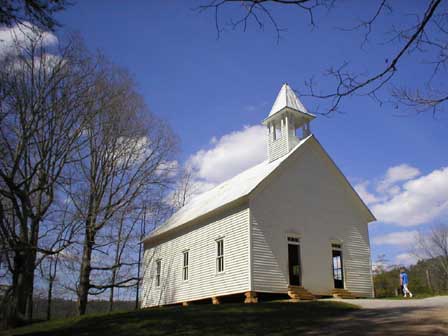
The small Methodist congregation began in the 1820s, meeting in a log cabin in the Cades Cove area of what is now the Great Smoky Mountains National Park. Almost a century later their descendants built the present structure, a simple, white siding building with two front doors – one for the men, the other for the women. The story goes that one man, a blacksmith and carpenter named J. D. McCampbell actually built it in 1915 in 115 days for $115, and then served as the congregation’s minister for several years.

The chapel sits empty now, the children of the builders evicted by the government when the Cove and the surrounding mountains were given national park status. The building is occupied only momentarily and sporadically by visitors who poke their heads in the doors and wander through the adjacent cemetery, or by wedding parties who sometimes seek out the beauty of Cades Cove and the novelty of the old church for their ceremonies, or by local churches who sometimes hold services there as prelude to their annual picnics in the park. But, it is still a holy place, made so by the worship and prayers and sacrifice of generations of mountain folk seeking – and finding – God in that place, by those who, by the grace of God, took their place in the communion of saints.

Just yesterday my wife and I visited this church again for the first time in several years. We said our prayers there and we sang the familiar hymns. As Clare played the old piano – which sounds now as tinny as any old western barroom piano – played “Leaning on the Everlasting Arms” and as we sang together, our choir of two swelled in size to include angels and archangels, prophets, apostles, martyrs, and all the company of heaven – the communion of saints – and those holy men and women of that small Methodist church lifted again their hymns of praise with us to our one God: Father, Son, and Holy Spirit. So the Scriptures and the Liturgy assure us.

The church of my childhood met in this old building several times, and saints of both groups – visible and invisible – mingled: Merl and Kathleen, Homer, Bob and Blanche, Carl and Mary Kate, Daisy, Edith, Wilsie – the names roll onward like a flood in my memory, all now in the heavenly kingdom. Those saints taught me of the great communion of saints, though they gave it a different emphasis. To them, the communion of saints was a present reality in the visible church, in the one, holy, catholic and Apostolic church of our Lord Jesus Christ – a communion that extended to the Baptists one street over, to the Methodist a couple of blocks east, to the Holiness Church on the corner, and yes, to the African-American church that met just across the alley running behind my house. Had they known of the Orthodox Church on Kingston Pike they would have included it, too, and the Catholic churches spread all over Knoxville. For them, the communion of saints was the reality of Paul’s words to the Ephesian saints:

There is one body and one Spirit, just as you were called in one hope of your calling; one Lord, one faith, one baptism; one God and Father of all, who is above all, and through all, and in you all (Eph 4:5-6, NKJV).

I come from less mystical than practical stock, but I believe they were right in what they taught me: if you can’t commune with those you see, it’s not likely that you can commune with the great, invisible host gone before.

And so, I celebrate this great communion of saints in that holy place in Cades Cove and in every holy place where the Gospel is truly proclaimed, the sacraments faithfully administered, and the faith fully embraced.

Through the prayers of our holy Fathers (and Mothers), Lord Jesus Christ our God, have mercy on us. Amen.

Wednesday, August 4, 2010

Reflection: To Kiss An Icon


The following quote is from Patmos: A Place of Healing for the Soul by Peter France – one of my favorite books. At this point in the account of his new-found life on Patmos, Peter is an agnostic moving ever so slightly toward the Orthodoxy that his wife has previously embraced. He finds himself in church for the night service before the Feast of the Dormition of the Theotokos. He writes:

A long queue of local people was waiting to kiss the wonder-working icon. Not having escaped to the fringes of the crowd, I was pulled in. We shuffled along, and as I chatted with people I knew – the electrician, the grocer, the carpenter, the plumber – I was struck by the fact that these people, practical workingmen with no very obvious religious slant to their lives, were doing something extremely odd. They were all patiently standing in their best suits waiting to kiss a painting. What was really going on?


I remembered something that Philip Sherrard, an Orthodox writer whom I admired, had written about Western society’s having lost its way. Materialism had become the creed of the majority, and it was opposed not by the churches but by those who claimed a vague spiritual allegiance or inkling which they insisted had nothing to do with “organized religion.” But Sherrard pointed out that any genuine religious tradition provided for some formal discipline as a means of spiritual realization. He wrote that people who attached themselves to these modern, rather gaseous trends of New Worldism were spiritually inferior to the simple believers who practiced a faith sincerely but with only the slightest knowledge of the metaphysical principles on which it was based.


As we stood in the queue at Diasozousa, I realized that these people, by the simple act of kissing the icon, were rejecting the closed system of materialism in which most people of the West are living today. Even if the act is a formal one, done because everybody does it, to revere an icon is to perform an action which proclaims that the material world is not the end – that there is a spiritual dimension to life which we may not understand and which we may ignore in our daily business of living but which on occasions such as this we can come together and publicly acknowledge. To kiss an icon, to cross oneself, to say “an theli o Theos” (“God willing”), however perfunctorily or unthinkingly these actions are performed, is to strike a blow at the closed universe of the materialist.