Friday, December 24, 2010

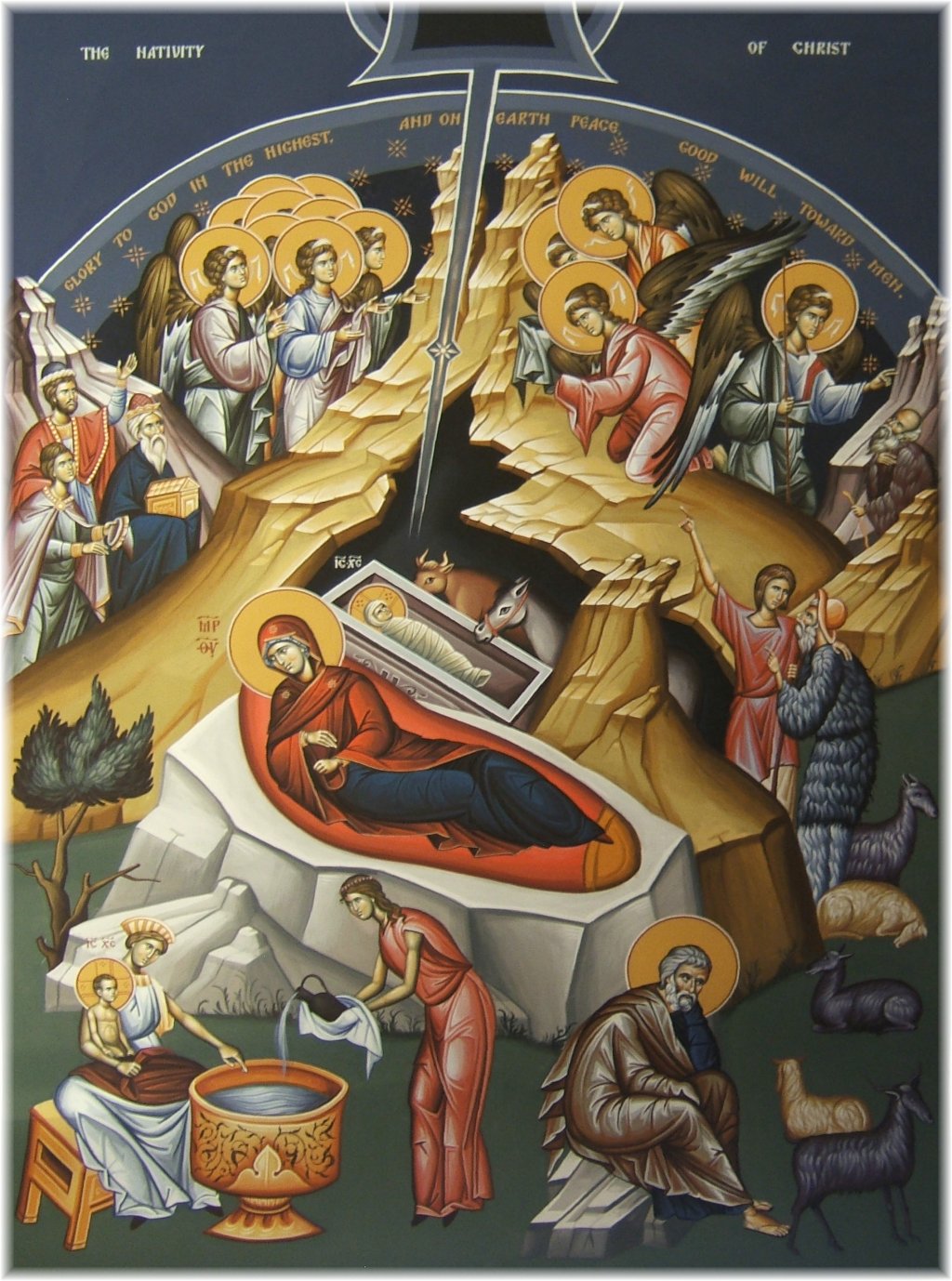
Eve of the Nativity: 24 December 2010


O come, let us rejoice in the Lord, as we declare this present mystery: The partition wall of disunion hath been destroyed, the flaming sword is turned back, and the Cherubim withdraw from the Tree of Life, and I partake of the food of Paradise, whence, because of disobedience, I was expelled. For the Image Immutable of the Father, the Image of his Eternity, taketh the form of a servant, having come forth from a Mother unwedded, yet having suffered no change: for that which he was that he remaineth, being very God; and that which he was not he hath assumed, becoming very man because of his love toward mankind. Unto him let us cry aloud: O God, who wast born of a Virgin, have mercy upon us.

Let heaven and earth today prophetically exult, and let Angels and men spiritually rejoice: for God hath revealed himself in the flesh unto those who were in darkness and sat in the shadow, and hath been born of a Virgin. The cavern and the manger have received him; Shepherds proclaim the marvel, and Magi from the Orient bring gifts unto Bethlehem. And we, also, with lips unworthy, do bring unto him praise in Angelic wise: Glory be to God on high, and on earth peace: for the Hope of the nations is come, and having come hath saved us from bondage to the enemy.

Christ is born: extol him! Christ from heaven: go to meet him! Christ on earth: be ye lifted up! Sing unto the Lord, all the whole earth, and praise him in song with joy, O ye people: For he hath glorified himself.

Glory to thee, O our God; glory to thee.

Andjeli Pevaju : Angels Sing -- A beautiful Serbian Christmas song


Prayers and hymns taken from the Service Book of the Holy Orthodox-Catholic Apostolic Church, Hapgood, Antiochian Orthodox Christian Archdiocese.

Friday, December 10, 2010

Advent 2: Christmas Carols and the Love of God


A local radio station begins non-stop Christmas music the day after Thanksgiving. As hard as I try to observe Advent and Christmas as separate liturgical seasons, I confess that I do reset my car radio dial (buttons, really) to make this the station of choice. After all, you don’t want to miss Dominick the Italian Christmas Donkey.

I like the schmaltzy old Christmas tunes and their classic singers: Nat King Cole, Johnny Mathis, Bing Crosby, Andy Williams, Burl Ives, Perry Como, and that whole generation of crooners. I don’t much like modern re-makes; their performers seem to try too hard to be novel, to “put their own spin” on the songs, and it mainly comes off as labored or pretentious or just poor quality music. I do very much like the instrumentals – selections from the Percy Faith Orchestra to the Windham Hill Christmas collections to Tingstad and Rumbel to Mannheim Steamroller. My wife and daughter mainly share these preferences so that our home and car are filled with music and there are no epic battles for control of the CD player or radio.

What I don’t care for are the songs – primarily of recent vintage – that get all touchy-feely with God’s emotions as he beholds his Son made flesh. A song new to me this year, and typical of the genre, treats God as a proud and protective Papa looking over his sleeping child, soothing him and wishing him sweet dreams. I've done that with my child; probably every father has. So it only makes sense that God acts this way too. Right? The trouble with this, with such cheap and easy sentimentality is that it reasons upward from man to God, that it creates God in our own image – God as man writ large. It posits God’s love as different in degree only – and not in kind – from human love. Take the best in man, increase it by a notch or two, and there you have God. While there is not a total disconnect between man and God – we are, after all, created in God’s image and likeness – reasoning upward from man to God is always moving in the wrong direction. We don’t know the love of God by comparison to human love; we know the love of God because he has revealed it to us in Jesus Christ and we try our best, in the Spirit, to conform our human love to this pattern. We do not so much reason our way to God as we listen to and observe his revelation, and ultimately as we unite ourselves to his revelation in Christ through faith and sacrament and obedience. As the great Advent prophet Isaiah calls to us:

Seek the Lord while he wills to be found; *
call upon him when he draws near.
Let the wicked forsake their ways *
and the evil ones their thoughts;
And let them turn to the Lord, and he will have compassion, *
and to our God, for he will richly pardon.
For my thoughts are not your thoughts, *
nor your ways my ways, says the Lord.
For as the heavens are higher than the earth, *
so are my ways higher than your ways,
and my thoughts than your thoughts.[1]

Christmas is a sentimental time, bound inextricably with memories of family and friends and children – especially children. But, we can’t allow our sentimentality to compromise our theology. God is love, as shown in the incarnation of Christ, yes, but also as shown in the Garden, on the cross, and in the tomb – not so much sentimental as absolutely determined to put creation to rights regardless of the cost. God’s love is a purifying fire, a “reckless, raging fury” as Rich Mullins described it.

These truths don’t necessarily make good Christmas carols, but they do make good Christians who can and do and will sing the praises of God now and ever and unto the ages of ages. Amen.


[1] The Book of Common Prayer, 1979. Canticle 10, The Second Song of Isaiah.

Thursday, December 9, 2010

Advent 2: Icons and Suffering


What follows cannot really be considered an Advent reflection except by the strictest of definitions: it is Advent and I have been reflecting on this lately; thus, it is an Advent reflection. Thematically, however, it is not so. Rather, it is a reflection on icons and suffering, occasioned by a book I have been asked to read – The Pursuit of God – and by certain experiences of my own which should and will remain private. Even out of season, I pray it might prove helpful to some.

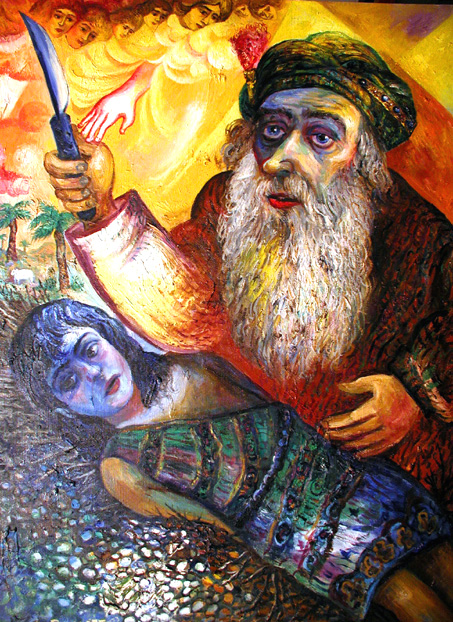
Abraham was old when Isaac was born, old enough indeed to have been his grandfather, and the child became at once the delight and idol of his heart. From that moment when he first stooped to take the tiny form awkwardly in his arms he was an eager love slave of his son. God went out of His way to comment on the strength of this affection. And it is not hard to understand. The baby represented everything sacred to his father’s heart: the promises of God, the covenants, the hopes of the years and the long messianic dream. As he watched him grow from babyhood to young manhood the heart of the old man was knit closer with the life of his son, till at last the relationship bordered upon the perilous. It was then that God stepped in to save both father and son from the consequences of an uncleansed love.[1]

A. W. Tozer interprets God’s command to sacrifice Isaac as the destruction of an idol – an unholy love for the son of the covenant – that had displaced Abraham’s single-hearted devotion to God. Perhaps it is so, since both Old Testament and New Testament commentators consider the binding of Isaac as a test of the old man’s faith in and devotion to God.

If we read the text Christologically, however, as did the Church Fathers, we find much more than a test of loyalty there. If in Isaac we see a type of Christ, then in Abraham we must also see a type of God. In asking him to sacrifice his son, his only son Isaac, God was inviting Abraham – and what an agonizing invitation it was – to image God before his son and ultimately before the world. Abraham was given the opportunity – and dare I say, the privilege – to become a flesh and blood icon of the God who would one day complete the sacrificial offering Abraham was asked only to initiate. It was in this act of faithful sacrifice that Abraham was conformed most fully to the likeness of the God who had called him. As with Abraham, so with Isaac: Isaac was never more conformed to the likeness of Jesus as when he was bound on the altar awaiting the fall of the knife.

Do we consider these men blessed to have been made iconic through their sacrifices: Abraham of his son and Isaac of his life? Is there any greater blessing than to be an image-bearer of God the Father or God the Son? How we answer these questions is important, not least because we have been called likewise to be image-bearers, specifically to be conformed to the likeness of the Son. And we will never be more iconic than when we are united to the suffering of Christ. It may well be that the world will never see Christ in us until we lay bound on our own altar of sacrifice awaiting with faithful fear the fall of the knife. May we, like Abraham and Isaac be faithful in our day as they were in theirs.

Almighty God, whose most dear Son went not up to joy but first he suffered pain, and entered not into glory before he was crucified: Mercifully grant that we, walking in the way of the cross, may find it none other than the way of life and peace; through Jesus Christ your Son our Lord. Amen.[2]

[1] Tozer, A. W. The Pursuit of God.
[2] The Book of Common Prayer 1979. Morning Prayer II, Collect for Fridays.

Sunday, November 28, 2010

Advent 1: Watch


We inhabit and are formed by story, inescapably so; our only real choice is which story or stories will form us. And many compete for that role. There is the patriotic story that forms us first as citizens ready to sacrifice all for the good of the nation/state. There is the commercial story that forms us first as producers and consumers willing to sacrifice all for economic security. There is the humanist story that forms us first as free and self-realized individuals willing to sacrifice all for personal happiness. And, there is the Christian story, that forms us first as the image-bearers of God, whose God was willing to sacrifice all for our salvation and for the reclamation of the cosmos. Which story will it be? We all must choose or others will be happy to choose for us.

Each story creates symbols and seasons, moments and rituals and objects in which the story is embedded and embodied. The Fourth of July is such a season and Old Glory is such a symbol in the patriotic story. Black Friday – and the whole season from just before Thanksgiving until just after New Year’s Day – serves the commercial story in a similar fashion. The Christian story has its Sacraments and its daily and weekly and yearly liturgies. Just now, the Christian story offers a symbol in time – the season of Advent. It is a way of making the story present to us again, of making us conscious of our place in it. And such consciousness is by no means easy to maintain. Advent shouts at us: Wake up – the night is far gone and the day is at hand. Your salvation is nearer now than when you first believed.

Advent relocates us in the midst of the story, far from Alpha, at an unknown remove from Omega and calls out – watch. St. Benedict began the prologue to his rule with the imperative listen; Advent begins with look. Look well in every direction possible: backward to the first advent – incarnation; forward to the last advent – parousia. But don’t forget to look around in the present, for we do not simply remember the once-present, now-absent Lord who will one day come again. We even now look around to see the Heavenly King, the Comforter, the Spirit of Truth Who is everywhere present and filling all things, the Treasury of good things and the Giver of life. We look for the Holy Spirit within and without to manifest God’s continuing presence with us. We look for the body of Christ, the church, to manifest God’s continuing presence with us. In the midst of the story, in the present moment, Advent proclaims, “Holy, holy, holy is the Lord God Almighty, Who was, and Who is, and Who is to come.”

Advent is the time to look, to keep watch, to be prepared. We keep on believing; we keep on loving; we keep on obeying. But,

We are not simply to believe, but to watch; not simply to love, but to watch; not simply to obey, but to watch…to be detached from what is present, and to live in what in unseen; to live in the thought of Christ as he came once, and as he will come again, to desire his second coming.[1]

The Anglican collect for this first Sunday of Advent says it well:

Almighty God, give us grace that we may cast away the works of darkness, and put upon us the armor of light, now in the time of this mortal life in which thy Son Jesus Christ came to visit us in great humility; that in the last day, when he shall come again in his glorious majesty to judge both the quick and the dead; we may rise to the life immortal; through him who liveth and reigneth with thee and the Holy Ghost, one God, now and for ever. Amen.

Watch.


[1] John Henry Newman, Parochial and Plain Sermons, quoted in Jon M. Sweeney, Cloister Talks.

Saturday, November 20, 2010

Thanksgiving and Personhood


Bart Ehrman is a New Testament scholar, a distinguished professor of religious studies at the University of North Carolina at Chapel Hill, a prolific author, and an agnostic – made so by his personal struggles with theodicy, the problem of suffering in a world created and ruled by a good God. I once heard a debate between Ehrman and Anglican Bishop N. T. Wright – himself a New Testament Scholar and recognized expert on the historical Jesus and Pauline studies– on this topic. Each scored a few debating points; neither offered much new in the perennial debate. The discussion was generally forgettable, with the exception of one moment of personal reflection by Ehrman. In recounting his loss of faith and its aftermath, Ehrman acknowledged a void left behind: the lack of anyone to give thanks to for the many moments of grace in his life. Without God, it is impossible to give thanks – though one may be genuinely thankful – for the many “accidental” blessings of life: the presence of a loving companion, the health of family, the abundance of goods, the joy of meaningful work. What do we do with these deep feelings of gratitude when no one is responsible for the blessings, when there is no one to thank? This is Ehrman’s – and any agnostic’s – dilemma, and Ehrman truthfully and courageously confesses it.

This haunting confession points to a deep truth of thanksgiving. It is not enough to feel vaguely, if genuinely, thankful. Thanks must be given; it must be expressed personally – from person to person. So one Eucharistic Prayer begins:

Celebrant: Let us give thanks to the Lord our God.
People: It is right to give him thanks and praise.
Celebrant: It is truly right to glorify you, Father, and to give you thanks; for you alone are God, living and true, dwelling in light inaccessible from before time and forever.

We come as person -- gathered in communion with other persons -- to Person. Christian thanksgiving -- and all true thanksgiving -- begins in personhood, in the recognition that the other has enriched you, that the other is a source of blessing. Christian thanksgiving begins with doxology, with the recognition and acknowledgement that God is the Other from Whom all blessings flow. Christian thanksgiving begins with prayer to God who is everywhere present and filling all things, the Treasury of good things and Giver of life.

Orthodox anthropology tells us that man is a tripartite being: body, soul, and spirit. The soul is both life force and mind, the reasoning, discursive aspect of man that grapples with such things as theodicy. The spirit is more central still. It perceives truth directly, unmediated by reason, truth revealed by Person to person. Thanksgiving lives in the spirit and transcends rational doubt. Ehrman knows -- and knows in the spirit -- that it is good and right, always and everywhere, to give thanks to the Father, the Almighty. More's the pity that he has no way now to do so.

By God's grace we do. And so, on this Feast of Thanksgiving -- and every day -- let us offer our tribute of thanks and praise to God: Creator, Redeemer, and Sanctifier.

Almighty God, Father of all mercies,
we your unworthy servants give you humble thanks
for all your goodness and loving kindness
to us and to all whom you have made.
We bless you for our creation, preservation,
and all the blessings of this life;
but above all for your immeasurable love
in the redemption of the world by our Lord Jesus Christ;
for the means of grace, and for the hope of glory.
And, we pray, give us such an awareness of your mercies,
that with truly thankful hearts we may show forth your praise,
not only with our lips, but in our lives,
by giving up our selves to your service,
and by walking before you
in holiness and righteousness all our days;
through Jesus Christ our Lord,
to whom, with you and the Holy Spirit,
be honor and glory throughout all ages. Amen.

Saturday, November 6, 2010

Feast of All Saints


All Saints’ Day: 7 November 2010
A Service of Memory at Lonsdale United Methodist Church
(Sirach 44:1-10, 13-15/1 Corinthians 11:23-26)
A Poor Sort of Memory

Grace to you, and peace, from God our Father and from the Lord Jesus Christ.

In the little corner of the Kingdom of God that I occupy, I would now greet my brothers and sisters in the Lord with these words: The Lord be with you.
And they would respond: And also with you.
And so, my dear brothers and sister in the Lord in this holy place, I greet you in the Lord’s name: The Lord be with you.

Let us pray.

Almighty God, you have knit together your elect in one communion and fellowship in the mystical body of your Son Christ our Lord: Give us grace so to follow your blessed saints in all virtuous and godly living, that we may come to those ineffable joys that you have prepared for those who truly love you; through Jesus Christ our Lord, who with you and the Holy Spirit lives and reigns, one God, in glory everlasting. Amen.

Hear the word of the Lord, given to Ben Sirach, some two centuries before the birth of Christ.

Let us now sing the praises of famous men,
our ancestors in their generations.
The Lord apportioned to them great glory,
his majesty from the beginning.
There were those who ruled in their kingdoms,
and made a name for themselves by their valor;
those who gave counsel because they were intelligent;
those who spoke in prophetic oracles;
those who led the people by their counsels
and by their knowledge of the people's lore;
they were wise in their words of instruction;
those who composed musical tunes,
or put verses in writing;
rich men endowed with resources,
living peacefully in their homes--
all these were honored in their generations,
and were the pride of their times.
Some of them have left behind a name,
so that others declare their praise.
But of others there is no memory;
they have perished as though they had never existed;
they have become as though they had never been born,
they and their children after them.
But these also were godly men,
whose righteous deeds have not been forgotten;
Their offspring will continue forever,
and their glory will never be blotted out.
Their bodies are buried in peace,
but their name lives on generation after generation.
The assembly declares
their wisdom,
and the congregation proclaims their praise (Ecclus 44:1-10, 13-15)[1].

On this feast of All Saints’, the scripture, and our hearts, tell us that it is a good and right and holy thing for the body of Christ to assemble and declare the wisdom of our fathers and mothers, to proclaim the praise of our godly brothers and sisters in the Lord – parents, children, husbands, wives, friends, relations – who have preceded us to the reward that awaits us all in Christ Jesus. So, let us sing the praises of those gone before, indeed; let us recount their righteous deeds. Let us remember.

Such memory lies very near the heart of our faith, and has from the beginning. The defining moment of the Jewish experience was, and is, the Exodus from Egypt, the moment when the Covenant God of Abraham, Isaac, and Jacob became the Savior God of his people, when he delivered them from bondage with a mighty hand and an outstretched arm. And even before that deliverance was complete, God had given his people a way to remember it: blood smeared on the doorposts and lintels of the houses; a hurried meal of roasted lamb, bitter herbs, unleavened bread, and wine; a festival of praise – the Passover.

“This day shall be a day of remembrance for you. You shall celebrate it as a festival to the LORD; throughout your generations you shall observe it as a perpetual ordinance.
When you come to the land that the LORD will give you, as he has promised, you shall keep this observance. And when your children ask you, ‘What do you mean by this observance?’ you shall say, ‘It is the Passover sacrifice to the LORD, for he passed over the houses of the Israelites in Egypt, when he struck down the Egyptians but spared our houses.’” And [hearing this] the people bowed down and worshiped
(Ex 12:14, 25-27).

Such memory lies very near the heart of our faith, and has from the beginning. The defining moment of the Christian experience was, and is, the crucifixion, the moment when God the Son became God the Savior of all people, when he delivered them from the bondage of sin and death with pierced hands and outstretched arms. And even before that deliverance was complete, our Lord had given his people a way to remember it: blood poured out and body broken – the bread of heaven and the cup of salvation – a festival of thanksgiving, the Eucharist.

[The] Lord Jesus on the night when he was betrayed took a loaf of bread, 24and when he had given thanks, he broke it and said, ‘This is my body that is for you. Do this in remembrance of me.’ 25In the same way he took the cup also, after supper, saying, ‘This cup is the new covenant in my blood. Do this, as often as you drink it, in remembrance of me.’ 26For as often as you eat this bread and drink the cup, you proclaim the Lord’s death until he comes (1 Cor 11:23b-26).

Such memory lies very near the heart of our faith, and has from the beginning.
The defining moment of the Church was, and is, Pentecost, the moment when God the Holy Spirit became God the Sanctifier of all flesh – sons and daughters, young men and old men, slaves, both men and women – when he filled them and empowered them with a mighty wind and with flames of fire. And even before the wind died down and the flames guttered out, our Lord had given his Church a way to remember.

So those who welcomed [Peter’s] message were baptized, and that day about three thousand persons were added. They devoted themselves to the apostles’ teaching and fellowship, to the breaking of bread and the prayers (Acts 2:41-42).

Yes, memory lies very near the heart of our faith, and has from the beginning. So, we remember the Exodus, which is, after all, our story, too – the story of all the spiritual offspring of Abraham. We remember the Lord’s death with bread and wine. We remember the Spirit’s presence with baptism, with the apostles’ teaching, with our fellowship, with the breaking of bread – the Lord’s Supper and our potluck suppers – and with the prayers. We remember too, the saints gone before: their righteous deeds, their witness, their encouragement. As Saint Paul reminds the Hebrews and us, we are surrounded by them, a great cloud of witnesses – the saints – among whom we count those whose names we call in this place and whose lives we celebrate on this day. Thanks be to God who is glorious in his saints.

Memory is central to our faith, but not just any kind of memory will do. As the White Queen said to Alice in Through the Looking Glass: “It is a poor sort of memory that only works backwards.” And, if true for Alice, how much more so for the people of God. It is a poor sort of memory that only works backwards – poor and unbecoming a faith such as ours. The beginning of the revelation of Jesus Christ given to Saint John is these words of Christ: “I am the Alpha and the Omega,” to which John adds, “who is and who was and who is to come, the Almighty” (Rev 1:8) – past, present, and future. And near the end of that same revelation – after seals are broken and trumpets blown and bowls poured out, after angels and beasts and dragons – the same words again: “I am the Alpha and the Omega, the first and the last, the beginning and the end” (Rev 22:13). The Alpha and the Omega, Jesus says repeatedly: I am the A and the Z. The trouble is, in this spiritual alphabet, we live somewhere around L, M, N, O, or P – stuck in the middle, far from A and Z. What we must have, then, is the kind of memory that looks not only backwards toward Alpha, but forward toward Omega, as well. What we must have is the kind of memory that Jesus sanctified when he gave us his great feast of memory: “For as often as you eat this bread and drink the cup, you proclaim the Lord’s death until he comes.” The communion we share with bread and wine, body and blood, is precisely the kind of memory we need. It is a memory that looks backwards to the Lord’s death and forward to his coming again. It is a poor sort of memory that only works backwards, but a powerful and holy memory that stands in the middle of time and sees both the Alpha and the Omega, the first and the last, the beginning and the end.

If our memory works only backwards, then this day’s All Saints’ observance, this service of memory we share, is a sad and pitiable thing: a time to remember what we once had but now have lost forever, a time to mourn love defeated by death, a time to stand helpless and hopeless before the same end that awaits us all. This is not celebration but lament, not feast but fast.

So, what is it that makes the difference between a poor sort of memory that works only backwards and a holy memory that stands in the middle of time and sees both beginning and end, A and Z, Alpha and Omega? What is it that allows us to stand in the midst of death and indescribable loss and yet see life and immeasurable gain? It is the great, good news of the gospel we proclaim this day and every day: Christ is risen from the dead, trampling down death by death, and upon those in the tombs bestowing life. It is the ancient victory cry of the church: “Christos anesti. Alithos anesti. Christ is risen! He is risen indeed!” It is the grand truth of Christ’s unconquerable love and boundless eternal life that allows us to stand by the graveside and through our tears yet raise the victory song, Alleluia! Alleluia! Alleluia! It is the faith of the saints gone before – the faith of these holy men and women we remember this day – saints far away and saints near, saints kin to us in spirit and saints kin to us in blood. This is what makes the difference between a poor sort of memory that works only backwards and a holy memory that stands in the middle of uncertain and troubled times and looks both backwards to God’s promises and forward to God’s blessings: Christ’s death, resurrection, and coming again.

If Christ has been raised, then we who are his will also be raised with him and like him. If Christ has been raised, then these saints we remember surround us not in silent, past testimony only, but as a living and present cloud of witnesses, cheering us on in the race of faith set before us, struggling with us for our salvation. If Christ has been raised, then

What I am saying, brothers and sisters, is this: flesh and blood cannot inherit the kingdom of God, nor does the perishable inherit the imperishable. 51Listen, I will tell you a mystery! We will not all die, but we will all be changed, 52in a moment, in the twinkling of an eye, at the last trumpet. For the trumpet will sound, and the dead will be raised imperishable, and we will be changed. 53For this perishable body must put on imperishability, and this mortal body must put on immortality. 54When this perishable body puts on imperishability, and this mortal body puts on immortality, then the saying that is written will be fulfilled:‘Death has been swallowed up in victory.’ 55 ‘Where, O death, is your victory? Where, O death, is your sting?’ 56The sting of death is sin, and the power of sin is the law. 57But thanks be to God, who gives us the victory through our Lord Jesus Christ (1 Cor 15:50-57).

And so, brothers and sisters, know this:

Christ has been raised from the dead, the first fruits of those who have died. For since death came through a [man], the resurrection of the dead has also come through a [man]; for as all die in Adam, so all will be made alive in Christ (1 Cor 15:20-22).

Thanks be to God for a holy and glorious memory that works both backwards and forward. And now, looking forward brothers and sisters, now is the time of our sainthood. Now is the time, in the presence of this great cloud of witnesses, for us to lay aside every weight and the sin that clings so closely. Now is the time for us to “run with perseverance the race that is set before us, looking to Jesus the pioneer and perfecter of our faith, who for the sake of the joy that was set before him endured the cross, disregarding its shame, and has taken his seat at the right hand of the throne of God” (Heb 12:1-2, adapted). Now is the time for us to be “steadfast, immovable, always excelling in the work of the Lord, because [we] know that in the Lord [our] labor is not in vain” (1 Cor 15:58, adapted). Now is the time to celebrate the saints gone before. Now is the time to celebrate the saints among us. Now is the time for us to take our place in that great cloud of witnesses. Now is the time to remember.

Let us pray.

Almighty God, you have surrounded us with a great cloud of witnesses:
Grant that we, encouraged by the good example of your servants,
may persevere in running the race that is set before us,
until at last we may with them attain to your eternal joy;
through Jesus Christ, the pioneer and perfecter of our faith,
who lives and reigns with you and the Holy Spirit,
one God, for ever and ever. Amen.

[1] Unless otherwise noted, all scripture is taken from the New Revised Standard Version Bible, copyright 1989, Division of Christian Education of the National Council of the Churches of Christ in the United States of America. Used by permission. All rights reserved.

Wednesday, November 3, 2010

The Logic of Atonement


I start with two confessions.

First, I am wholly inadequate to write about, or even to contemplate, the atonement, by which I mean the full scope of Christ’s redeeming work for the cosmos: incarnation, life, death, descent into hell, resurrection, ascension, return, and judgment. So, you would be perfectly justified – no pun intended – to stop reading at this point; you would be wise, indeed, to do so if you expect wisdom to follow. And, yet, I am compelled to contemplate and to write – even with fear and trembling – if for no other reasons than to marvel at the atonement and to worship the One who loved us so.

Second, none of the atonement theories on offer make any sense to me – and, please know that I have none better to offer. East and West, Orthodox and Catholic and Protestant, Calvinist and Arminian: none of them makes sense to me. Every atonement theory, or so it seems to me, attempts to apply an external logic that compels God to behave in a certain way. And therein lies the problem.

“That which is not assumed, cannot be healed,” Gregory of Nazianzus tell us by way of logically compelling the incarnation. But why? Could God not heal in another way? Is he helpless before some external logic and forced to act in this particular way of incarnation?

Because God is perfectly just he cannot forgive sin only; he must punish it, Anselm, and hosts of others, tell us by way of logically mandating the crucifixion. Again, why? Surely, the father of the Prodigal Son did not stand on honor or justice but rather delighted in forgiving sin and reconciling his son to himself. Is God more constrained by some external logic than the God-figure in the story told by God the Son?

Every atonement theory I have encountered falls prey to this same problem: each invokes some external logic to compel God’s behavior. In essence, each theory might well start with, “Oh, God had to do this (whatever this is) because …”. And that, I cannot accept. While we might argue over human free will, certainly we must accord God the status of being truly sovereign. God had to do nothing. God chose to do everything. And the difference is vast.

I find nothing logical about atonement history. Read the Old Testament – on its own merit and not through the lens of the New Testament. (I know this is not really feasible, but imagine it nonetheless.) Would you really have predicted the incarnation, death, and resurrection of God the Son? I find no inherent logic in the story that compels God to act as he chose to act in Jesus. Reading the Gospels for the first time I can imagine someone responding, “Who would have guessed?” Oh, there are hints and shadows and prophecies aplenty in the Old Testament, but they are apparent, if at all, only after the facts of the New Testament. Philip started with Jesus and explained the prophets to the Ethiopian and not the other way around. Starting with Jesus you can understand the Old Testament, but, starting with the Old Testament, I don’t think you can predict Jesus and the atonement. My ways are not your ways and my thoughts are not your thoughts, God said, and truly this is so.

So, I find that I cannot say, “God did this because.” Instead, I can and must say, “Because God did this…”. I mean simply this: I cannot logically explain the atonement, but I can enumerate the blessings of the atonement. Unlike Saint Gregory, I cannot say that God had to assume my nature in the incarnation to heal my nature, but I can and do say that because God assumed my nature in the incarnation, my nature may be healed. Unlike Anselm, I cannot say that God had to punish sin to satisfy the just requirements of the law, but I can and do say that because God destroyed sin in the body of Christ crucified, the law lays no legitimate claim on me. There is an enormous difference – and not mere semantics – between “God had to,” and “Because God did.”

Perhaps I’m doing little more than echoing Saint Paul:

For the message about the cross is foolishness to those who are perishing, but to us who are being saved it is the power of God. 19For it is written,‘I will destroy the wisdom of the wise, and the discernment of the discerning I will thwart.’ 20Where is the one who is wise? Where is the scribe? Where is the debater of this age? Has not God made foolish the wisdom of the world? 21For since, in the wisdom of God, the world did not know God through wisdom, God decided, through the foolishness of our proclamation, to save those who believe. 22For Jews demand signs and Greeks desire wisdom, 23but we proclaim Christ crucified, a stumbling-block to Jews and foolishness to Gentiles, 24but to those who are the called, both Jews and Greeks, Christ the power of God and the wisdom of God. 25For God’s foolishness is wiser than human wisdom, and God’s weakness is stronger than human strength (1 Cor 1:18-25, NRSV).

While I am convinced that there is no external logic that compelled the atonement, I know also, beyond reason or doubt, that there is an internal logic to the atonement that compels me – an internal logic that transcends reason and makes meaning, that transcends death and makes life.

At some point perhaps we stop trying to understand the cross of Christ by external, human logic and simply start trying to stand under the cross of Christ by the mercy and grace of the God who so loved us in this shocking and unprecedented manner. With the mind in the heart, let us venerate the cross of Christ and worship the One who died there for us.