Saturday, April 23, 2011

Hristos Voskrese


It is an old and simple tale, familiar in many forms, almost certainly apocryphal. Yet it is worth the telling again, for it is deeply true.

It is the 1920s in Communist Russia. A minor Party functionary has been dispatched to a small town to close its Orthodox church. He gathers the entire populace in the square and for hours rails against the faith, demonstrating conclusively that its doctrines are false, its miracles – particularly the Resurrection – are lies, and it canons oppressive. The Party is the way forward; to the Party belongs the future. Satisfied with his commanding performance, the official prepares to leave when the town’s old priest rises and asks to address the people. Dismissively, the official grants him two minutes – not a second more. “I will not need that long,” says the priest. “I have only two words.”

The priest mounts the podium, faces the people, crosses himself in the name of the Father and of the Son and of the Holy Spirit, and in a loud voice proclaims to the crowd, “Hristos voskrese (Christ is risen)!” Hearing the words which had been proclaimed for a thousand years in all their churches, the people stand as one and shout, “Voistinu voskrese (He is risen indeed)!”

The church has been speaking this truth to power from the moment the stone rolled away from the tomb and Christ strode forward trampling down death by death and upon those in the tombs bestowing life. Let us take our place in this long line of proclamation and confess, not only with our lips but in our lives:

Hristos voskrese.
Voistinu voskrese.

Christos anesti.
Alithos anesti.

Alleluia! Christ is risen!
The Lord is risen indeed. Alleluia!

Friday, April 22, 2011

Holy Saturday: Rejoice, O Adam


You, O Adam, are become unto us as Egypt,
for in you were we sold into bondage,
in you did we know a harsh taskmaster,
a stubborn and heart-hardened Pharaoh,
in you did sin bind us and death strike us down.

Your firstborn son, O Adam, was not flesh and blood, but death:
his birthright your offspring,
his inheritance Hades.
To him did we all go down and make obeisance.
To him were we all enslaved.

But God came to Horeb, O Adam,
and there appeared in the womb of the Virgin –
a bush burning but not consumed,
a womb bearing but undefiled,
holy ground on which God spoke his name in flesh and blood.

I am the God of your father –
the God of Abraham, the God of Isaac, the God of Jacob.
I have surely seen the oppression of my people in Egypt,
and I know their sorrows.
So I have come, O Adam; I will deliver them, O Egypt.

Behold, O Adam, the Paschal Lamb –
the Lamb of God who takes away the sin of the world – comes to you.
Thus says the Lord, the God of Israel: Let my people go.
Harken not to this word, O Death, and harden your heart, O Sin,
that the Lord may strike you with the rod of his power.

Look now, O Adam; see the Lamb slain,
high and lifted up on the tree of life, blood staining doorposts and lintels.
Now is judgment come upon you, O Egypt,
now is the rod of iron shattered,
now are the chains rent asunder.

Woe to your firstborn son, O Adam,
for death has come upon death and the sea of Hades is parted
as a curtain rent from top to bottom.
A way is made through the sea, through the veil,
for all your free children are led by cloud and fire, by wind and Spirit.

Rejoice in this Passover, O Adam,
for you, too, are set free
and made in Him a land of promise.
You are not left desolate but are taken by the hand
and led forth in triumphal procession.

Rejoice in this Passover, O Adam,
for death is trampled down by death,
bondage is bound, and Hades is despoiled.
Rejoice in this Passover, O Adam, for the Lamb has paid the debt of your sin,
and by his blood delivered your faithful children.


[I commend to your reading a reflection for Holy Saturday by St. Epiphanios of Salamis posted at Full of Grace and Truth: Christ's Descent Into Hades.]

Wednesday, April 20, 2011

For They Do Not Know What They Do


32 There were also two others, criminals, led with Him to be put to death. 33 And when they had come to the place called Calvary, there they crucified Him, and the criminals, one on the right hand and the other on the left. 34 Then Jesus said, “Father, forgive them, for they do not know what they do” (Luke 23:32-34a, NKJV).

These words of Jesus puzzle me: they do not know what they do. But surely, no matter how we try to rehabilitate him, Judas knew that he was betraying a good and holy man into the hands of evil and violent men, all for the sake of thirty pieces of silver. Surely, Pilate knew, even as he washed his hands of the whole Jesus affair, that he was signing the death warrant of an innocent man, all for the sake of political expediency. Surely, Peter knew, even before the cock crowed, that his words of denial were lies told for the sake of personal safety: he did know the man and he did know his own cowardice in that crucial moment. What then can Jesus’ words mean: “Father, forgive them, for they do not know what they do”?

Could they mean this: that the scope and impact of sin go far beyond our ability to know and understand? Might it be that my sin – no matter how trivial it seems – further subjects all creation to futility ( cf Rom 8:19-25) and makes me complicit in earthquake, tsunami, famine, drought and all unnatural “natural disasters”? Might it be that my sin – no matter how trivial it seems – cedes spiritual territory in the Kingdom of God to the Rebel and Enemy and makes me complicit in the lies he spreads and the snares he sets, makes me complicit in the sum total of evil in the world? Might it be that my sin – no matter how trivial it seems – ripples both forward and backward in time and makes me complicit in the Holocaust and the Rwandan Genocide and in all such unspeakable acts that yet may occur? I do not know, and that is precisely the point: I do not know. God alone – the Lamb of God who takes away the sin of the world – knows the full weight and scope and impact of my sin. And so he prayed, for me no less than for those who crucified him on that great and terrible day, “Father, forgive them, for they do not know what they do.”

I am a sinner; that I know. But, in the eyes of the law – really, any reasonable human law – my sins do not rise to the level of capital crimes. The death penalty is not even on the table. And yet, the cross proclaims otherwise. My sins, judged trivial by the courts of human justice and popular opinion – and, God forgive me, even by myself – caused our Lord Jesus to spread out his arms on the hard wood of the cross. My sin resulted the in capital punishment of God incarnate; I am guilty of deicide. I had no idea. I did not know. And that, again, is precisely the point. And so Jesus prayed, for me no less than for those who crucified him on that great and terrible day, “Father, forgive them, for they do not know what they do.”

While ignorance is no excuse, I suspect it is a great mercy. The 1928 Book of Common Prayer contains these lines in the Eucharistic prayer of confession:

ALMIGHTY God, Father of our Lord Jesus Christ, Maker of all things, Judge of all men; We acknowledge and bewail our manifold sins and wickedness, Which we, from time to time, most grievously have committed, By thought, word, and deed, Against thy Divine Majesty, Provoking most justly thy wrath and indignation against us. We do earnestly repent, And are heartily sorry for these our misdoings; The remembrance of them is grievous unto us; The burden of them is intolerable.


If the limited knowledge we have of our sins is “grievous unto us,” if the “burden of them is intolerable,” then how could we possibly live under the weight of full knowledge? Ignorance is surely a grace-filled bliss. Thanks be to God that we do not know what we do. We need only know that Jesus is the Lamb of God who takes away the sin of the world, who takes away our sins committed in ignorance. Thanks be to God that our Lord Jesus prayed, “Father, forgive them, for they do not know what they do.”

As We Forgive


‘Pray then in this way:
Our Father in heaven,
hallowed be your name.
Your kingdom come.
Your will be done,
on earth as it is in heaven.
Give us this day our daily bread.
And forgive us our debts,
as we also have forgiven our debtors.
And do not bring us to the time of trial,
but rescue us from the evil one.

For if you forgive others their trespasses, your heavenly Father will also forgive you; but if you do not forgive others, neither will your Father forgive your trespasses.

The individualization of faith is a persistent problem in Western theology – the emphasis on the personal to the neglect of the corporate. “Have you accepted Jesus Christ as your personal Lord and Savior?” is the prime evangelical inquiry posed to each individual. There seems to be no corporate counterpart, however: “Have you, as a church, accepted Jesus Christ as your corporate Lord and Savior?” I have never heard that question, or any equivalent, asked.

Yet, scripture surely emphasizes the corporate as much as it does the individual. The narrative structure of the salvation story is corporate. God forms a family from Abraham and a people for himself and works cosmic salvation through Israel. Jesus comes preaching not personal salvation but the citizenship in the Kingdom of God. At Pentecost, the Holy Spirit breathes life into individuals to form the church. The triune nature of God and of salvation history is inherently corporate.

St. Paul champions the corporate and unapologetically situates the individual within the corporate context of the church, as this extended selection from 1 Corinthians 12 shows.

But as it is, God arranged the members in the body, each one of them, as he chose. If all were a single member, where would the body be? As it is, there are many members, yet one body. The eye cannot say to the hand, ‘I have no need of you’, nor again the head to the feet, ‘I have no need of you.’ On the contrary, the members of the body that seem to be weaker are indispensable, and those members of the body that we think less honourable we clothe with greater honour, and our less respectable members are treated with greater respect; whereas our more respectable members do not need this. But God has so arranged the body, giving the greater honour to the inferior member, that there may be no dissension within the body, but the members may have the same care for one another. If one member suffers, all suffer together with it; if one member is honoured, all rejoice together with it.

Now you are the body of Christ and individually members of it
(1 Cor 12:18-27, NRSV).

If one member suffers, all suffer together with it. Every individual action has corporate implications. Might the same hold true for sin? If one member sins, all sin together with it? I do not want to press this too far and eliminate individual responsibility, but neither do I wish to minimize the corporate effects of sin. It is simply not possible for an individual member of the body of Christ to sin without harming the entire body, without enmeshing the entire body in the consequences of that sin. Perhaps you have seen a church rent asunder by the sin of an individual, making corporate and public what was thought to be individual and private?

If sin is ultimately a corporate affair, then, forgiveness must also be corporate. If a member of the body sins against me and I refuse to forgive, then I bind that sin to the very body of which I am part. My refusal to forgive binds my brother’s sin to me and to the church of which we are both members. I cannot be forgiven if I am unwilling to forgive. Forgiveness of others is not an arbitrary prerequisite to my own forgiveness; it is the only forward into my own forgiveness. I cannot loose sin from myself by binding it to other members of the body to which I belong.

For if you forgive others their trespasses, your heavenly Father will also forgive you; but if you do not forgive others, neither will your Father forgive your trespasses. This is not a bargain we make with God; I will forgive only so God will then forgive me. It is, rather, the very way in which God forgives. Unbinding my brother through forgiveness, looses his sin from the body and thus from me. It cannot be otherwise. In the body of Christ, nothing is purely individual – neither sin nor forgiveness. Thus, we confess our sin not only to God and not only to a priest, but to the whole body of Christ. The bidding to Confession of Sin in Morning Prayer (BCP 79) embodies this corporate aspect of confession and forgiveness:

Dearly beloved, we have come together in the presence of Almighty God our heavenly Father, to set forth his praise, to hear his holy Word, and to ask, for ourselves and on behalf of others, those things that are necessary for our life and our salvation. And so that we may prepare ourselves in heart and mind to worship him, let us kneel in silence, and with penitent and obedient hearts confess our sins, that we may obtain forgiveness by his infinite goodness and mercy. Let us confess our sins against God and our neighbor.

Following this bidding, we confess that we have sinned and we pray that God will have mercy on us. Through our incorporation into Christ, we become more part of one another than we can begin to imagine. Through the mercy of God, forgive this sinner please, even as I also forgive you.

Saturday, April 2, 2011

Sermon: 4 Lent 2011 -- Signs and Miracles


Sermon: 4 Lent 2011

(John 6:1-14)

Signs and Miracles: Abundance and Incarnation


In the name of the Father, and of the Son, and of the Holy Spirit. Amen.


We now have come to the middle of our Lenten journey, a journey of prayer and fasting and almsgiving. Lent provides time and space for us to reflect on Jesus and on ourselves, on who we are and who, by God’s grace, we have yet to become. The Lenten pilgrimage is also a season of confession and repentance. And so, I will begin today with a confession of my own. I confess before God and you, my brothers and sisters, that I do not believe in miracles any longer. I once did, but I have repented of it. I mean, of course, that I do not believe in miracles as they are typically understood. In our prevailing Western culture, a miracle is a disruption of nature. A miracle is God stepping into the physical world from which he is normally absent and rarely welcome to violate the laws of nature that govern that physical world. Miracles are the creation of a people who have forgotten that God is everywhere present, filling all things. Miracles are the creation of a people who have forgotten that it is in God that we live and move and have our being. Miracles are the creation of a people who have forgotten that the sun rose this morning not because of Kepler or Newton or even because of natural law built into a clockwork universe, but because our God in his providential care spoke into the darkness once again and said, “Let there be light.” Miracles are not Christian; they are the stuff of mythology or paganism or deism, but not of Christianity. For in Christianity God is Emmanuel – God With Us – feeding the sparrows, clothing the flowers, making his sun rise on the evil and the good, and sending rain on the righteous and the unrighteous – intimately involved with every aspect of his creation. God is not absent from us. He does not need to step into the world, for his is already and always here. Christ is in our midst: he is and ever shall be.


Our faith really owns only one miracle, for truly only one miracle has occurred from the foundations of the world: the incarnation of the Word.


1 In the beginning was the Word, and the Word was with God, and the Word was God. 2 He was in the beginning with God. 3 All things were made through Him, and without Him nothing was made that was made. 4 In Him was life, and the life was the light of men. 5 And the light shines in the darkness, and the darkness did not comprehend it. 14 And the Word became flesh and dwelt among us, and we beheld His glory, the glory as of the only begotten of the Father, full of grace and truth (John 1:1-5, 14, NKJV).


The incarnation – the Word becoming flesh and dwelling among us – is the only true miracle, for in the incarnation God did step into his creation from outside it. God the creator became part of his creation in a way that he was not before, and that disrupted the laws of fallen nature: the incarnate God was born of a virgin; the incarnate God was tempted in all things as we are yet without sin; the incarnate God was crucified, died, and was buried; the incarnate God rose triumphant on the third day trampling down death by death and on those in the tombs bestowing life. The incarnation is the one and only, truly Christian miracle, and everything flows from it as surely as the blood flowed from the pierced hands and feet of our God-become-flesh, as surely as the river of the water of life flows from the throne of God and of the Lamb (cf Rev 22:1).


St. John the Evangelist did not believe in miracles either, even though he saw wonder upon wonder in company with Jesus. He never uses the word “miracle” in his gospel, though some English translations impose it on him. Instead, John writes of the “signs” (semeion) that accompany Jesus’ presence. Following the changing of the water into wine at the wedding at Cana, John writes:


Jesus did this, the first of his signs, in Cana of Galilee and revealed his glory; and his disciples believed in him (John 2:11, NRSV).


Signs are not disruptions of nature, but are revelations of God’s presence in his creation, revelations of the glory of God in the face of Christ, given that we might believe. Signs are the inevitable result of the miracle of the incarnation, sparks scattered glowing and sizzling from the burning bush of God’s presence. If Christ is in our midst – if God is indeed among us in human form – then signs of his presence must follow.


Once John the Baptist sent two of his disciples to Jesus.


20 When the men had come to Him, they said, “John the Baptist has sent us to You, saying, ‘Are You the Coming One, or do we look for another?’” 21 And that very hour He cured many of infirmities, afflictions, and evil spirits; and to many blind He gave sight. 22 Jesus answered and said to them, “Go and tell John the things you have seen and heard: that the blind see, the lame walk, the lepers are cleansed, the deaf hear, the dead are raised, the poor have the gospel preached to them (Lk 7:20-23, NKJV).


Well, of course: these are the signs that simply must follow the miracle of incarnation. When God is with us, creation is restored and men are saved and such signs point to Jesus. The signs that follow Jesus are not self-referential. They don’t point to themselves, but to something else; that is precisely what makes them signs. Signs point the way. Signs attract attention only to direct that attention to something else or to Someone else. The purpose of each healing was not merely to restore health, but to direct attention to the Healer. The purpose of each act of cleansing was not merely to restore ritual purity, but to direct attention to the Lamb of God who takes away the sin of the world. The purpose of each sign was to direct attention to the miracle of the incarnation, to the miracle of God-With-Us, and to our incarnate God’s redemptive purpose among us.


One of the clearest signs of God-With-Us is abundance. When Israel left Egypt at the first Passover, they left as newly freed slaves with a slave mentality still firmly intact, a mentality of lack: lack of power, lack of freedom, lack of security, lack of rest. The grumbling into which they often lapsed during this period is a reflection of the lack they had known and of their uncertainty about Moses’ and his God’s ability to provide.


When the forces of pharaoh pursued Israel to the Red Sea, Israel cried out to Moses:


“Because there were no graves in Egypt, have you taken us away to die in the wilderness? Why have you so dealt with us, to bring us up out of Egypt? 12 Is this not the word that we told you in Egypt, saying, ‘Let us alone that we may serve the Egyptians’? For it would have been better for us to serve the Egyptians than that we should die in the wilderness” (Ex 14:12b-14, NKJV).


We lack power. We lack security. But Moses replied, “The LORD will fight for you, and you shall hold your peace” (Ex 14:14, NKJV). The LORD is God-With-Us, and the sign of his presence is abundance of power and security.


On the fifteenth day of the second month of their freedom, Israel complained again against Moses and Aaron in the Wilderness of Sin:


“Oh, that we had died by the hand of the LORD in the land of Egypt, when we sat by the pots of meat and when we ate bread to the full! For you have brought us out into this wilderness to kill this whole assembly with hunger” (Ex 16:3b, NKJV).


We lack food – meat and bread. And the LORD rained bread from heaven – manna – and meat from the sky – quail – and everyone had enough. The LORD is God-With-Us, and the sign of his presence is abundance of food.


Finally, after forty years of unlearning the slave mentality of lack, Israel came to the land of promise, a land flowing with milk and honey, a land rich in grapes and olives and figs, a land of pasture for sheep. The LORD is God-With-Us, and the sign of his presence is abundance. When the LORD is God-With-Us, no one goes hungry; there is enough and to spare.


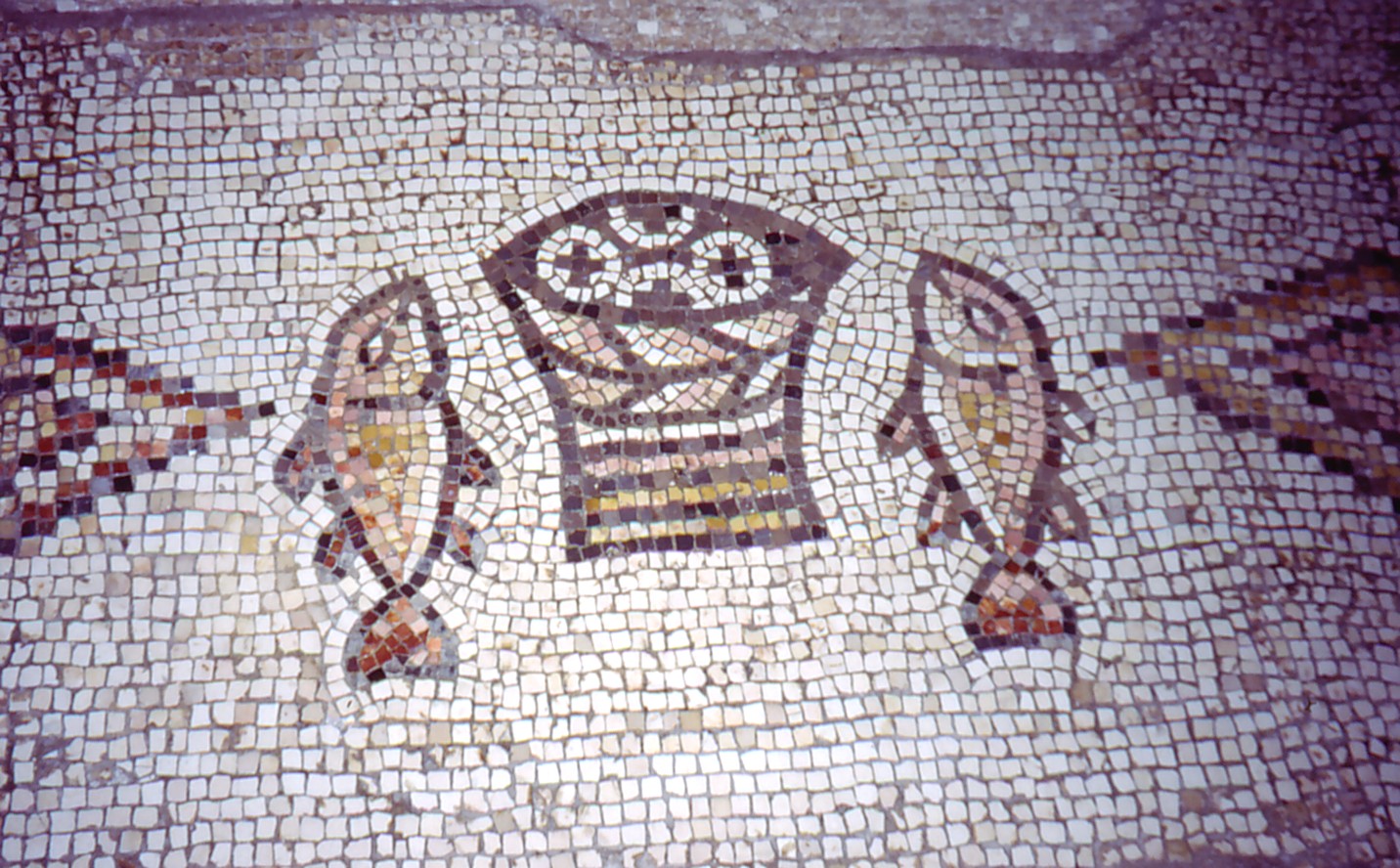
In this day’s Gospel another Passover is near and Israel gathers on a mountainside around the prophet – not Moses this time, but Jesus of Nazareth. They are hungry; they lack meat and bread. When Jesus proposes that his disciples feed them, Philip reminds him that they also lack money. Andrew snags a little boy’s lunch – five barley loaves and two fish – but what is that among so many? We lack food, Jesus – meat and bread – and we lack money with which to buy.


And so the stage is set for the great proclamation: God is with us, and the sign of his presence is abundance. When God is with us, no one goes hungry; there is enough and to spare.


“Make the people sit down,” is all Jesus says. Then he takes the loaves, gives thanks, and distributes them to the people, and then likewise with the fish: Jesus conducting a Eucharist of bread and meat.


John, who chronicles this event, wants us all to understand: this sign of abundance, like every other sign he documents, points to the one and only great miracle, the miracle of the incarnation – God is with us, in flesh and blood, in the person of this Galilean carpenter turned rabbi. One stands among us on this near Passover who is greater than Moses on that great, first Passover, for the one who stands among us is I Am. The one who stands among us giving us bread and fish is the same God who provided manna and quail to Israel. The one who stands among us brings such abundance that 12 basketsful of bread and fish remain – one for each tribe of Israel, one for each disciple of new Israel. Our God – this sign proclaims – is Emmanuel, the God of abundance, the God of leftovers.


Still, John presses the point; he will not let us miss the incarnation to which this sign of abundant bread points. He records a conversation between Jesus and the Jews just days later at the synagogue of Capernaum. Jesus says:


48 I am the bread of life. 49 Your fathers ate the manna in the wilderness, and are dead. 50 This is the bread which comes down from heaven, that one may eat of it and not die. 51 I am the living bread which came down from heaven. If anyone eats of this bread, he will live forever; and the bread that I shall give is My flesh, which I shall give for the life of the world.” 52 The Jews therefore quarreled among themselves, saying, “How can this Man give us His flesh to eat?” 53 Then Jesus said to them, “Most assuredly, I say to you, unless you eat the flesh of the Son of Man and drink His blood, you have no life in you. 54 Whoever eats My flesh and drinks My blood has eternal life, and I will raise him up at the last day. 55 For My flesh is food indeed, and My blood is drink indeed. 56 He who eats My flesh and drinks My blood abides in Me, and I in him. 57 As the living Father sent Me, and I live because of the Father, so he who feeds on Me will live because of Me. 58 This is the bread which came down from heaven—not as your fathers ate the manna, and are dead. He who eats this bread will live forever” (John 6:48-58, NKJV).

Manna and quail, bread and fish: these fill the belly and sustain physical life for a time. But, the bread which comes down from heaven – the body and blood of God incarnate – that fills the soul and sustains eternal life, abundant life through the incarnation. The manna and the barley loaves were signs of the miracle of the incarnation – God-With-Us. The Eucharist with its bread and wine is the sacramental sign of the miracle of the incarnation, a sign which proclaims that God is still with us. In the Eucharist Christ becomes incarnate in bread and wine and in those who eat and drink, and abundant life follows.


If Christ is in our midst – if God is indeed with us and among us – then signs of his presence will and must follow. If Christ is indeed incarnate – not just as a rabbi teaching on the hills of Galilee, but in the bread and wine on which we feast and in the lives of those who eat and drink – then abundance must be manifest. If Christ is with even two or three who gather in his name – if Christ is with the Church – then the Church must exhibit such signs of abundance that the world can no longer ignore the miracle of the incarnation and the redemptive work of Christ in restoring the cosmos. And what are these signs of abundance?


Worship – an abundance of worship – is a sign the world cannot easily ignore: “Come, let us sing to the Lord. Let us shout for joy to the Rock of our salvation” (Ps 95:1, BCP). Not just any worship will do, of course: certainly not worship from the lips when the heart is far from God, and certainly not worship as ritual or entertainment. No. True worship – worship in Spirit and truth, worship that gives right glory to our God and Father through Jesus Christ in the Holy Spirit – is worship that is unshaken by earthquake, worship that is not drowned by tsunami, worship that is unbowed before tyrants, worship that gives voice to all creation in praise that rises from the heart and pours from the lips in the first and natural language of mankind, the language heard in Eden before the fall: “Glory be to Thee, our God. Glory be to Thee.” This kind of worship is a sign to the world that indeed God is with us.


Love – an abundance of love – is a sign the world cannot easily ignore: “By this all will know that you are My disciples, if you have love for one another,” Jesus said and says still (John 13:35, NKJV). Not just any love will do, of course, and certainly not the romance or lust or even the casual friendship that often pass for love. No. Love as a sign of the incarnation is love that feeds the hungry, clothes the naked, binds up the broken, welcomes the stranger, forgives the enemy, prays for the persecutor, and lays down its life – all at once or day by day – for the sake of those who hate. This kind of love is a sign to the world that indeed God is with us.


Grace – an abundance of grace – is a sign the world cannot easily ignore. Not just any grace will do, of course, and certainly not grace as mere gentility or courtesy. No. Grace as a sign of the incarnation is nothing less than the presence and activity of God. An experience of true grace wakens the world from its sleep and makes it cry out like Jacob at Bethel, “The Lord is in this place, and I did not know it” (Gen 28:16b, LXX, The Orthodox Study Bible). Grace enters the pain of the world and stretches out its arms on the hard wood of the cross to share in, and as much as possible, to bear the pain of the world, bringing God’s presence into its darkest places. This kind of grace is a sign to the world that indeed God is with us.


Hope – an abundance of hope – is a sign the world cannot easily ignore. Not just any hope will do, of course, and certainly not hope that is barely disguised naïveté or rosy optimism. No. Hope as a sign of the incarnation is nothing less than stubborn and rock-solid eschatology – living in this present age with the certainty that Christ has already conquered every enemy and is even now putting the world to rights, living in this present age with the certainty that the last days have already dawned and the glorious consummation of all things is guaranteed, living in this present age with the proclamation always in our hearts and often on our lips:


Jesus Christ is Lord, and

Christ has died. Christ is risen. Christ will come again.


This kind of hope is a sign to the world that indeed God is with us.


None of these are miracles; I do not believe in miracles. They are signs, and I do believe in signs of the one and only great miracle, the incarnation of our Lord Jesus Christ through which he conquered sin and death and reconciled man to God. And I do believe that, with Christ in our midst, signs of abundance will and must accompany the church – abundance of worship, abundance of love, abundance of hope, abundance of grace. These signs in the lives of broken but redeemed men and women and children will awaken the world to the glory, wonder, and power of the incarnation. Five barley loaves and two fish fed a hungry crowd. A little bread and wine can feed the world and restore the cosmos. It does not take miracles – just signs. Amen.
Saturday, March 19, 2011

Sermon, 2 Lent 2011: This Vexing Little "Dud" of a Story


2 Lent 2011
(Matthew 15:21-28)
This Vexing Little “Dud” of a Story

In the name of the Father, and the Son, and the Holy Spirit. Amen.

Most preachers, I suspect, hope for a text that allows for a certain rhetorical eloquence or else deep, theological reflection, or – well, anything other than what is on offer in this vexing little “dud” of story given us in the lectionary this morning, a story in which the very sympathetic character of a mother humiliates herself before Jesus and a crowd of onlookers for the sake of her sick child, only to be ignored and then rebuffed by the Master himself. Now, you tell me: what am I supposed to do with that?

Part of the problem is that the lectionary today, as it so often does, sets us down right in the middle of an ongoing drama and expects us to understand – without context – what is happening. I can, I think, at least remedy that part of the problem.

Jesus and his disciples are home, north in Galilee, by the sea. He has lately received news that his kinsman and forerunner, John, has been executed – albeit reluctantly – by the decree of Herod. Jesus wants to be alone for awhile: to pray, to reflect. But the crowds follow him, sick and hungry, a vast multitude of need. So, moved to compassion, Jesus heals them and feeds them, over five thousand men, with five loaves and two fish – a miracle Matthew describes with intentional Eucharist imagery.

Jesus then sends his disciples on ahead of him by boat to Gennesaret, while he dismisses the crowd and prays through the night. During the fourth watch – sometime between 3 and 6 a.m. – Jesus finally rejoins the disciples, walking on the water and calming the storm in which these experienced fishermen find themselves helpless. As so, this small boatload of weary men comes to Gennesaret. And a crowd gathers and once again Jesus heals them.

Then they arrive, the scribes and Pharisees; they arrive from Jerusalem with a burning question of crucial importance: “Why do your disciples break the tradition of the elders? For they do not wash their hands before they eat” (Mt 15:2, NRSV). Really, guys? Herod has just executed your countryman, a man considered a prophet of God by the masses, and you walk 75 miles from Jerusalem just to question my personal hygiene? Really, guys? I’ve just fed five thousand men with a sack lunch and healed countless more by letting them touch the hem of my garment, and you want to talk about dirty hands? Really guys? I’ve just walked on water and calmed a storm – all with unwashed hands, I might add – and it’s the unwashed hands that interest you?

It really does sound ludicrous, doesn’t it – trivia in the face of monumental truth? But is wasn’t trivial at all to the Pharisees; it was a matter of national and religious survival and yes, they had walked 75 miles to challenge Jesus on this and they would have walked 750 miles, if necessary. Theirs was a mission of homeland security as it had been for nearly two hundred fifty years. They had learned from their fathers and grandfathers and from generations before that the only way to maintain national identity in the face of occupation and persecution was through strict and absolute fidelity to the Law. Their name was their philosophy: Pharisee – the separate ones, the ones who separated themselves from the pagans and from their apostate countrymen through faithfulness to the letter of God’s law, through their purity. So, yes, under the present Roman occupation the washing of hands was important. So, yes, under the present Roman occupation Jesus was a threat: a renegade rabbi and worker of wonders who gathered sinners and tax collectors, the poor and disenfranchised, and God knows who else about himself and taught them – by example, if not by word – to ignore the Law. It was a matter of purity, and purity was a matter of survival.

“Why do your disciples break the tradition of the elders? For they do not wash their hands before they eat.”

Jesus minces no words in his response; he, too, knows this is about purity, and he intends to properly redefine the whole notion.

7 Hypocrites! Well did Isaiah prophesy about you, saying: 8 ‘ These people draw near to Me with their mouth, And honor Me with their lips, But their heart is far from Me. 9 And in vain they worship Me, Teaching as doctrines the commandments of men.’” 10 When He had called the multitude to Himself, He said to them, “Hear and understand: 11 Not what goes into the mouth defiles a man; but what comes out of the mouth, this defiles a man” (Mt 15:7-9, NKJV).

And there it is; for Jesus, purity is not a matter of the hands, but of the heart: “Create in me a clean heart, O God, and renew a right spirit within me” (Ps 51:10) just as David had prayed. What the Pharisees do not yet understand, but perhaps suspect and fear, is that Jesus is redefining national and religious identity, creating a new Israel with himself at the center, a new Israel whose badges of identity are not purity of hands and faithfulness to the Law, but purity of heart and faithfulness to Jesus, a new Israel not defined by ethnicity but by humility.

This is a lot to process and, as usual, the disciples are confused, before and probably even after Jesus explains his purity code in detail:

16 So Jesus said, “Are you also still without understanding? 17 Do you not yet understand that whatever enters the mouth goes into the stomach and is eliminated? 18 But those things which proceed out of the mouth come from the heart, and they defile a man. 19 For out of the heart proceed evil thoughts, murders, adulteries, fornications, thefts, false witness, blasphemies. 20 These are the things which defile a man, but to eat with unwashed hands does not defile a man” (Mt 15:16-20, NKJV).

And with this the group is off again, this time north to Tyre and Sidon, to a defiled gentile region where the purity-conscious Pharisees are unlikely to follow, and where the disciples can see true purity and faithfulness, where they can glimpse new Israel, incarnate in the person of a Canaanite woman.

And so, perhaps we come now to our vexing little “dud” of a story with clearer eyes and deeper understanding. We find that this encounter is nothing less than an in-breaking of the kingdom of God – in Tyre and Sidon, of all places – an eschatological moment in which the last days intersect this day and all is renewed and a Canaanite woman is redeemed by the God of Israel.

The story does not start that way, however.

21 Then Jesus went out from there and departed to the region of Tyre and Sidon. 22 And behold, a woman of Canaan came from that region and cried out to Him, saying, “Have mercy on me, O Lord, Son of David! My daughter is severely demon-possessed.” 23 But He answered her not a word. And His disciples came and urged Him, saying, “Send her away, for she cries out after us” (Mt 15:21-23, NKJV).

The irony here isn’t subtle at all, is it? The Pharisees, whom Jesus thought to leave behind in Gennesaret, have followed him to Phoenicia – in the persons of his own disciples. She is unclean, Lord, an impure gentile; send her away. And so, for a moment, Jesus plays the role they request and expect – plays a role in order ultimately to vindicate this Canaanite woman, to open the eyes of his disciples, to purify their hearts and minds, and to give us all a glimpse of the new Israel – the kingdom of God.


24 But He answered and said, “I was not sent except to the lost sheep of the house of Israel.

And this, of course, is true. Jesus is the fulfillment of the covenant given to Abraham, Isaac, and Jacob. Jesus is the completion of the law and the hope of the prophets. Jesus’ mission is to the Jew first, but then also to the Greek. For in first becoming Israel’s messiah, Jesus also becomes the savior of the world, the redeemer of all men, the restorer of the cosmos. In coming first to the lost sheep of the house of Israel, Jesus comes to gather all lost sheep – from flocks we never dreamed of – into one fold, true Israel, with one shepherd, the Lord Jesus Christ.


25 Then she came and worshiped Him, saying, “Lord, help me!” 26 But He answered and said, “It is not good to take the children’s bread and throw it to the little dogs.” 27 And she said, “Yes, Lord, yet even the little dogs eat the crumbs which fall from their masters’ table.”

What a climax for the story. Jesus affords this “impure” Canaanite woman the opportunity to vindicate herself in the eyes of his disciples who have yet to grasp the true nature of purity, gives her the opportunity to show that amidst all this abstract, theological talk of purity she is the one pure soul there – a soul made pure and shown to be pure by humility and faith: “Yes, Lord, yet even the little dogs eat the crumbs which fall from their masters’ table.”

The next words were spoken by Jesus, and though he spoke to the Canaanite woman, I can well imagine that he looked straight at his disciples, straight into their pharisaical hearts and spoke to them, as well: See, it isn’t about washed hands or even about ethnic identity. It’s about this, about this woman, about this woman’s faith.


28 Then Jesus answered and said to her, “O woman, great is your faith! Let it be to you as you desire.” And her daughter was healed from that very hour.

And, as Anglicans are wont to say, Here endeth the lesson. But, the question hangs in the air, asked of the disciples and of us: What will you do with this vexing little “dud” of a story?

The answer comes, in part, through a hymn of the Eastern church – a hymn that lies very near the heart of Orthodox piety:

A most compunctionate hymn do I, the unworthy one, offer Thee, and like the Canaanitish woman, I cry to Thee: O Jesus, have mercy on me! For not a daughter, but a flesh have I which is violently possessed by the passions and troubled with anger. Grant Thou healing to me, who cry aloud to Thee: Alleluia ( from The Akathist Hymn To Jesus Christ, A Prayer Book for Orthodox Christians).

This hymn calls us to acknowledge that we are – each of us – the daughter of the Canaanite woman, a daughter grappling with forces too powerful for us, with “no power of ourselves to help ourselves” (The Collect, The Second Sunday of Lent, BCP 1928). It calls us to acknowledge that St. Paul’s words describe us better than we know or wish:

For I delight in the law of God according to the inward man. But I see another law in my members, warring against the law of my mind, and bringing me into captivity to the law of sin which is in my members. O wretched man that I am! Who will deliver me from this body of death (Rom 8:22-24, NKJV)?

So we cry: O Jesus, have mercy on us. Grant thou healing to those who cry aloud to Thee: Alleluia. And in response, dare we hear Jesus’ words to the woman as his words to us? “Great is your faith. Let it be to you as you desire.” Dare we hope that, just as he healed that faithful woman’s daughter from that very hour, he will so heal us? Yes: thanks be to God, who gives us the victory through our Lord Jesus Christ (1 Cor 15:57, NKJV).

This vexing little “dud” of story is, in reality, a blessed great gem of a story, a kingdom story that proclaims freedom from bondage and abundant life for all who come in faith crying out: O Jesus, have mercy on us.

Still, the question hangs in the air, asked of the disciples and of us: What will you do with this vexing little “dud” of a story?

The answer comes, in part, through a prayer – a Eucharistic prayer – that lies very near the heart of Anglican piety:

We do not presume to come to this thy Table, O merciful Lord, trusting in our own righteousness, but in thy manifold and great mercies. We are not worthy so much as to gather up the crumbs under thy Table. But thou art the same Lord, whose property is always to have mercy: Grant us therefore, gracious Lord, so to eat the flesh of thy dear Son Jesus Christ, and to drink his blood, that our sinful bodies may be made clean by his body, and our souls washed through his most precious blood, and that we may evermore dwell in him, and he in us. Amen.

Each time we offer this prayer of humble access, we acknowledge that we are – each of us – the Canaanite woman, coming to Jesus with no righteousness of our own, coming to Jesus with no right to do so, coming to Jesus hoping against hope just to gather up crumbs under his table. And, expecting nothing, deserving nothing, through his astounding grace we are given everything: not our righteousness, but his perfect righteousness; not crumbs but a feast – the bread of heaven and the cup of salvation. No longer are we impure: our sinful bodies are made clean by his body, and our souls are washed by his most precious blood. Like the Canaanite woman, we find ourselves vindicated in the sight of heaven and earth through humility, faith, and grace. Dare we hear Jesus’ words to the woman as his words to us? “Great is your faith. Let it be to you as you desire.” Yes, for in this feast, our Father – and what a privilege to say those words – our Father,

dost assure us thereby of thy favour and goodness towards us; and that we are very members incorporate in the mystical body of thy Son, which is the blessed company of all faithful people; and are also heirs through hope of thy everlasting kingdom, by the merits of his most precious death and passion.

This vexing little “dud” of story is, in reality, a blessed great gem of a story, a kingdom story that breaks down all barriers of purity and ethnicity and creates a new people of God:

For you are all sons of God through faith in Christ. For as many of you as were baptized into Christ have put on Christ. There is neither Jew nor Greek, there is neither slave nor free, there is neither male nor female; for you are all one in Christ Jesus. And if you are Christ’s, then you are Abraham’s seed, and heirs according to the promise (Gal 3:26-29, NKJV).

The Church Fathers – Origen, Chrysostom, and others – saw the Canaanite woman as the archetype of the gentile church, the fulfillment of what was spoken by the prophet Joel:

17 ‘ And it shall come to pass in the last days, says God, That I will pour out of My Spirit on all flesh; Your sons and your daughters shall prophesy, Your young men shall see visions, Your old men shall dream dreams. 18 And on My menservants and on My maidservants I will pour out My Spirit in those days; And they shall prophesy. 19 I will show wonders in heaven above And signs in the earth beneath: Blood and fire and vapor of smoke. 20 The sun shall be turned into darkness, And the moon into blood, Before the coming of the great and awesome day of the LORD. 21 And it shall come to pass That whoever calls on the name of the LORD Shall be saved’ (Acts 2:17-21, NKJV).

Dare we find ourselves in this prophecy – sons and daughters, vessels of the Holy Spirit, those who, through the name of LORD, know the salvation of the LORD? Yes, for we know this vexing little “dud” of a story to be a blessed great gem of a story, a gospel story of great good news: forgiveness, healing, adoption, salvation.

Church tradition provides names for many of the “unnamed” characters in the Gospel narratives: Photini is the woman at the well in Sychar; Ignatius is the child Jesus called to his side as an example of humility. This Canaanite woman, though, is not given a name by tradition. Perhaps she remains unnamed because she is much more than a single individual, much greater than one person’s name. She is everyone who comes to Christ pleading for undeserved mercy, everyone who comes to Christ hoping for unmerited grace; everyone who comes to Christ to gather crumbs under his table only to be invited to the wedding banquet of the Lamb. She is you and she is me and she is all of us together. And this vexing little “dud” of story is in truth a blessed great gem of a story – the gospel in the life and person of this one Canaanite woman. Amen.

Wednesday, March 16, 2011

Memory Eternal: John William Carty, II (1940-2011)


In the name of the Father, and of the Son, and of the Holy Spirit. Amen.

We were never meant to be here like this, mourning in the presence of death. It was not so from the beginning, when our God spoke into the void from the heart of the Trinity and said, “Let there be,” and worlds were born and the morning stars sang together.

We were never meant to be here like this, powerless in the face of an ancient foe. It was not so from the beginning, when our God formed man from the dust of the earth and breathed into him the breath of life, and man became a living being.

We were never meant to be here like this, standing at the edge of the grave. It was not so from the beginning when God planted in the Garden the tree of life from which man was to eat freely and so to live abundantly.

We were never meant to be here like this: aching, longing, weeping. It was not so from the beginning when God said, “Of every tree of the garden you may freely eat; but of the tree of the knowledge of good and evil you shall not eat, for in the day that you eat of it you shall surely die.”

We were never meant to be here like this, mouths and bellies full of the fruit of that tree, slaves to sin and death, exiled from the Garden and from the tree of life, returning to the dust from which we came. It was not so from the beginning when God surveyed his creation and said, “It is good; it is very good.”

And yet, here we are, where we were never meant to be.

A stone’s throw from Jerusalem two sisters grieved the death of their beloved brother Lazarus. Standing at the sealed tomb they knew with heart-breaking certainty, we were never meant to be here like this. They had sent for the Master; they knew he could heal their brother. They had sent for the Master and he had not come. He was here now, too late. Each of the sisters confronted Jesus with that hard truth – first Martha, then Mary: If you had been here, our brother would not have died. And so, we are here now where we were never meant to be because you did not come. And Jesus’ words of comfort and truth almost surely fell on ears deafened by grief.

Jesus went to the tomb, and seeing it, he wept. He wept because he, better than any, knew the truth: We were never meant to be here like this. It was not so from the beginning when I called you into being, when I gave you life, when I made you lords of creation and called you to tend the garden and be fruitful. It was not so from the beginning when you were called to grow in grace and glory and share the very life of the Trinity. We were never meant to be here like this.

And so, Jesus cried with a loud voice, “Lazarus, come forth!” And he who had died came out, for we were never intended to linger at the grave.

Some time later, on a hill on the outskirts of Jerusalem this same Jesus – the Resurrection and the Life – hung suspended between earth and sky on a cross of our own making, fashioned by the sins of the world, dying the death of all men. And his mother and a few faithful disciples – women and men – cried in their hearts at the foot of that cross: We were never meant to be here like this. And Jesus himself voiced the same as he cried out with a loud voice saying, “My God, My God, why have You forsaken Me?” He cried not for himself alone, but for all who in the face of certain death know we were never meant to be here like this; he cried out for us here, this day. And then, it was finished.

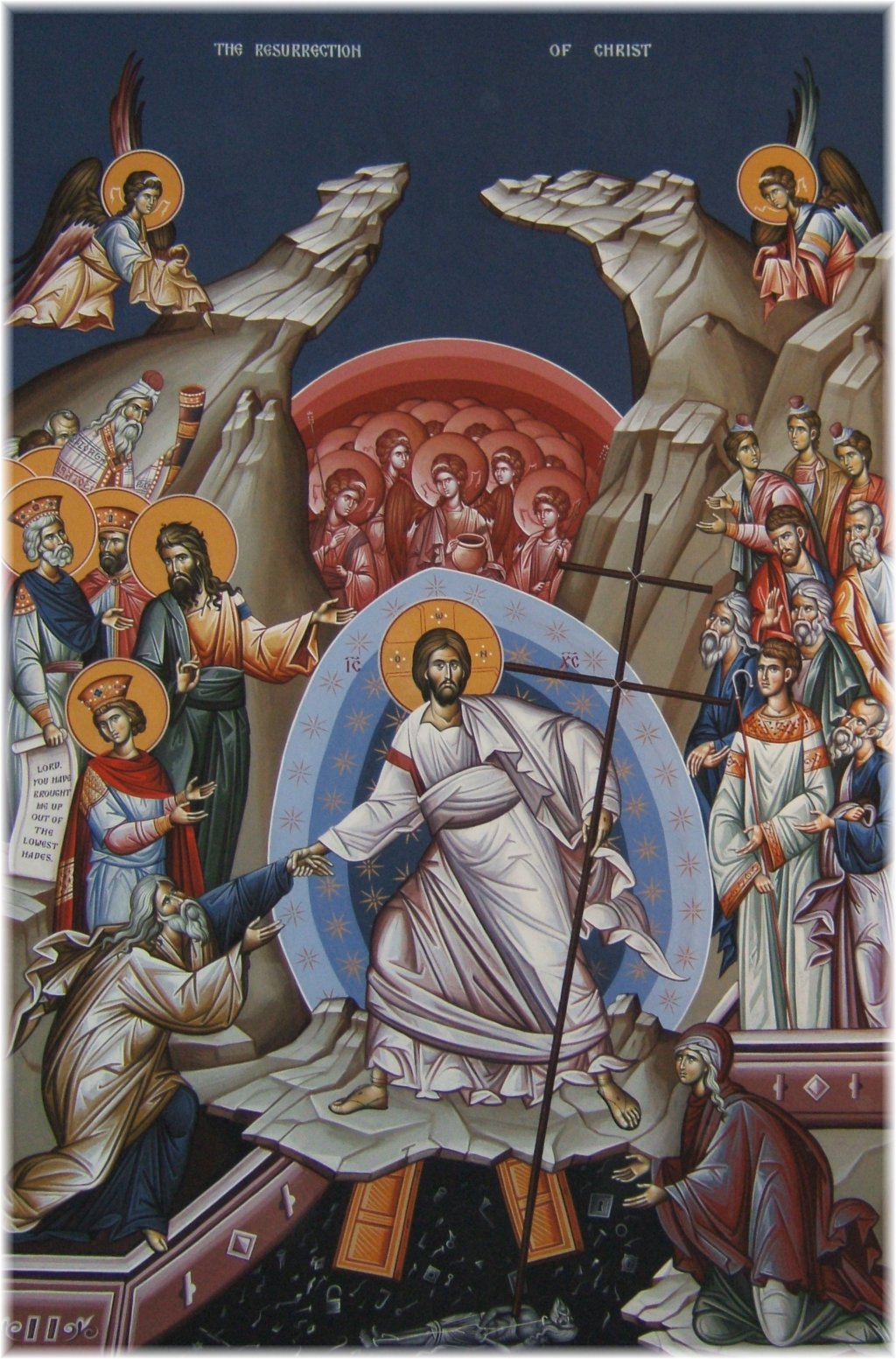
The disciples took their Master’s body, laid him in a tomb, and sealed him there with a great stone. They could not know the mystery about to unfold, the mystery hinted at in Scripture, written in icon, and sung in the praises of the church. He descended to the dead the Creed says. Indeed. And when he descended to the dead he stormed the gates of death and hell, took by their hands our righteous fathers and mothers – Adam and Eve; Abraham and Sarah; Isaac and Jacob, Moses and Aaron and Miriam, Saul and David and Solomon, Isaiah and Jeremiah and John the Baptist – took them by their hands and led them forth from captivity with the shout, “Come forth! You were never meant to be here like this!”

And on the third day – on the first day of the week very early in the morning – on the outskirts of Jerusalem the earth trembled, the angels descended, and the great stone rolled away. The women – mourners come to anoint the body of Jesus – entered the tomb and saw a young man clothed in a long white robe sitting on the right side; and they were alarmed. But he said to them, “Do not be alarmed. You seek Jesus of Nazareth, who was crucified. He is risen! He is not here.” He was never meant to stay here; nor are you. Go, tell his disciples.

Just days ago we entered the season of Lent. Church tradition tells us that we are not to say the alleluia again until the great Vigil of Easter. But gathered here this day, gathered in the presence of death, gathered where we were never meant to be, we have no choice and so we cry out:

Alleluia! Christ is risen from the dead trampling down death by death and on those in the tombs bestowing life.

Alleluia! Christ is risen. The Lord is risen indeed. Alleluia!

And if Christ is risen, then we, too, shall rise,

in a moment, in the twinkling of an eye, at the last trumpet. For the trumpet will sound, and the dead will be raised incorruptible, and we shall be changed. For this corruptible must put on incorruption, and this mortal must put on immortality…Then shall be brought to pass the saying that is written: “Death is swallowed up in victory.”

“O Death, where is your sting?
O Hades, where is your victory?”

Thanks be to God who gives us the victory through our Lord Jesus Christ
(1 Cor 15: selections, NKJV).

And so, Ginny, Pete, Kevin, and Ginny Lynn; Kathy, Kay, and Clare; all Bill’s family and friends, I say to you – yet, not I but the church – grieve, but not as those without hope. Grieve as those who know we were never meant to be here, as those who Christ has brought forth from a place of darkness and death into the realm of light and life. Grieve as those who know with a certainty passing all grief, that Christ met his servant Bill in the hour of death and said to him, “Come forth! You were never meant to be here like this.” Grieve for a time, but only for a time, for death has been swallowed up in victory, and we were never meant to linger by the grave. Grieve for a time, but only for a time, and then go forth singing:

Alleluia! Christ is risen. The Lord is risen indeed. Alleluia!

Beloved, comfort one another with these words. Amen.